


I will never deny that making changes to your health and fitness is hard. The first time I meet a client, they often come in all over the place, immediately listing every “bad” habit they have. And sometimes, I’ll even smile and say, “I bet you do 100 other things wrong.” They usually look at me funny, and I follow up with, “But let’s figure out the top two more important for now.”
The Myth of Overnight Perfection

Over the years, I’ve noticed common patterns in people who are just starting their fitness journey. People are incredibly hard on themselves. They expect change to happen instantly, as if progress should be rated on a scale from 1 to 10 overnight. Even when the change is small—like keeping your feet properly aligned while standing on a chair—clients often expect perfection immediately.
Here’s the truth: it won’t be fixed tomorrow, and that’s okay. Change isn’t just physical; it’s physiological, biomechanical, and mental. And above all, it requires patience. Giving yourself grace and compassion during this process is key. You are not going to be perfect, nor should you be.
The Non-Linear Path to Progress
The path from point A to point B—and eventually to point C—is not linear. You’ll move forward, take a step back, revisit old habits, and then move forward again. It’s a cycle: up, down, sideways. The important thing is to view progress over time—compare where you are this year to last year, and where you want to be next year. Small, incremental changes matter more than drastic overnight transformations.
Embracing the 80-20 Principle
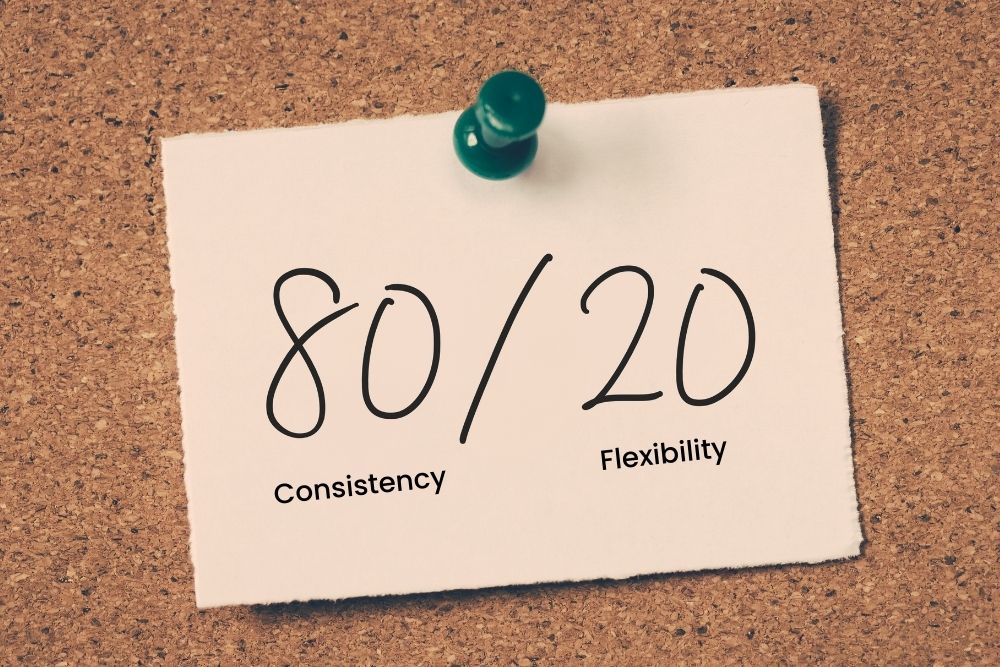
Slip-ups are not failures—they’re part of the process. The people who embrace this idea tend to get the best results. I always say fitness and nutrition are about the 80-20 principle: 80% consistency, 20% flexibility. That 20% allows for being human, for life happening, and for the unexpected challenges that arise. The 80% is about showing up and committing, but it isn’t about perfection—it’s about consistency and patience.
Navigating the Discomfort of Change

Making changes—whether it’s cutting sugar, adding more protein to your diet, or simply moving more—is often uncomfortable. Sometimes you need to take steps backward to move forward. These moments are some of the most important; they strip away old habits and mental barriers. I often tell clients: “Pay for your sin, and then move on.” Day one and day 10,000 are equally important in the journey, and every step deserves recognition.
The Courage to Start Small
One of the most beautiful parts of life is the ability to reinvent or redevelop yourself. But it takes courage to start small, to give yourself grace, and to accept that setbacks and unexpected challenges are part of the journey. And, in the end, those challenges are what make life worth living.
To see a real-world example of how these principles look in practice, you can read about my own fitness and wellness journey and how I learned to prioritize adaptability over intensity.